The questions people ask us most about food labels and the campaign.
Campaign news, new resources and upcoming events, straight to your inbox. Unsubscribe at any time.
Food policy is how a government shapes the food environment: what is sold, how it is labelled, how it is marketed and what is served in public institutions.
Food policy is the set of laws, regulations and public programmes that determine what food is available, how it is presented to consumers and how it is marketed. It covers labelling rules, marketing restrictions, nutrition standards and the food served in schools, hospitals and other public institutions.
Well-designed food policy makes healthy choices easier for everyone, without relying on each shopper to decode a detailed nutrition panel on the back of a pack.
A Ministry of Health landscape analysis of Uganda's food environment (2025) found that processed and ultra-processed foods now dominate supermarket and grocery shelves, with many products containing excessive amounts of sugar, salt and unhealthy fats.
72.1% of prepackaged food products in supermarkets and grocery stores are ultra-processed foods and beverages. 56% of processed and ultra-processed prepackaged foods on Uganda's market exceed recommended sodium thresholds, 48% contain excessive free sugars and 46% exceed saturated fat thresholds. Additional findings show that 38% are high in total fat, while 8% contain elevated levels of trans fat.
72.1%
of prepackaged supermarket and grocery products are ultra-processed foods and beverages
Source: Ministry of Health, Uganda food environment landscape analysis, 2025
56%
exceed recommended sodium thresholds
Source: Ministry of Health, Uganda food environment landscape analysis, 2025
48%
contain excessive free sugars
Source: Ministry of Health, Uganda food environment landscape analysis, 2025
46%
exceed saturated fat thresholds
Source: Ministry of Health, Uganda food environment landscape analysis, 2025
38%
are high in total fat
Source: Ministry of Health, Uganda food environment landscape analysis, 2025
8%
contain elevated levels of trans fat
Source: Ministry of Health, Uganda food environment landscape analysis, 2025
The Uganda Nutrient Profile Model (NPM) is a technical and scientific tool that sets thresholds for nutrients and ingredients of critical concern (sugar, fat, sodium/salt) in processed and ultra-processed foods and non-alcoholic beverages sold in Uganda.
The NPM identifies products that are high in free sugars, sodium, saturated fat, trans fat, total fat and non-sugar sweeteners. It determines when a product should be considered healthier or less healthy based on established thresholds, and it provides the foundation for implementing Front-of-Pack Warning Labelling, restricting unhealthy food marketing (especially to children) and supporting healthier public food procurement policies.

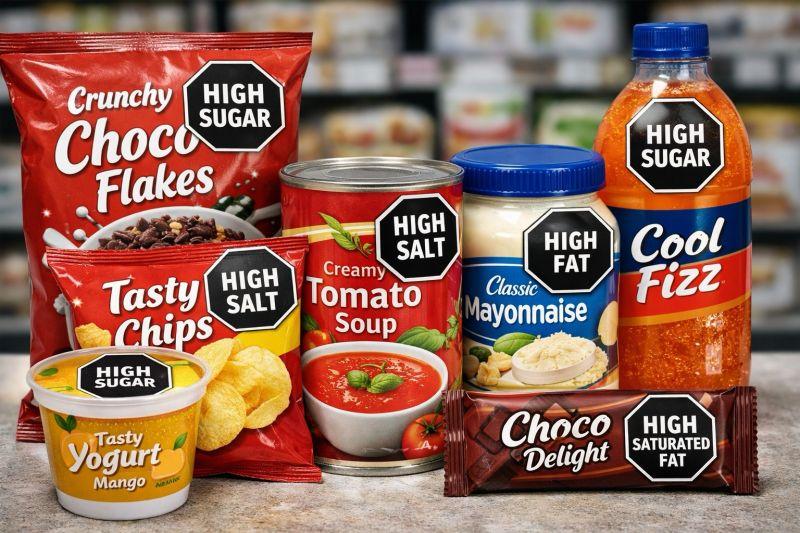
Front-of-Pack Warning Labels are clear, easy-to-read nutrition labels placed on the front of food packages to help consumers quickly identify products that are high in nutrients and ingredients of critical concern. Unlike detailed nutrition panels on the back of packaging, they provide simple, at-a-glance information that helps consumers make informed food choices while shopping.
Front-of-Pack Warning Labelling is one of several policy tools built on the Uganda Nutrient Profile Model. The campaign is advocating for it to be mandatory. Uganda has not yet adopted mandatory FoPWL.
Read what the campaign is asking for, what a warning label looks like, and what difference mandatory labelling could make.
The Uganda Nutrient Profile Model provides the technical basis for restricting the marketing of unhealthy food, especially to children. Defining which products count as high in nutrients of critical concern, with clear thresholds, makes marketing restrictions enforceable rather than discretionary.
Children are a particularly important audience: the food marketing they see shapes their preferences and their long-term diets.
Public institutions such as schools, hospitals, prisons and government offices buy food at scale. Applying the thresholds of the Uganda Nutrient Profile Model to public procurement means the food served in public institutions contributes to healthier diets instead of undermining them.
Healthy public procurement is the third use of the same thresholds: what is labelled, what is marketed and what is bought by government all follow the NPM.
The relationship between the tools is deliberate. The Uganda Nutrient Profile Model defines the thresholds; the other measures apply them:
See what the Uganda National Food Policy Coalition is calling for, and how you can support it.